
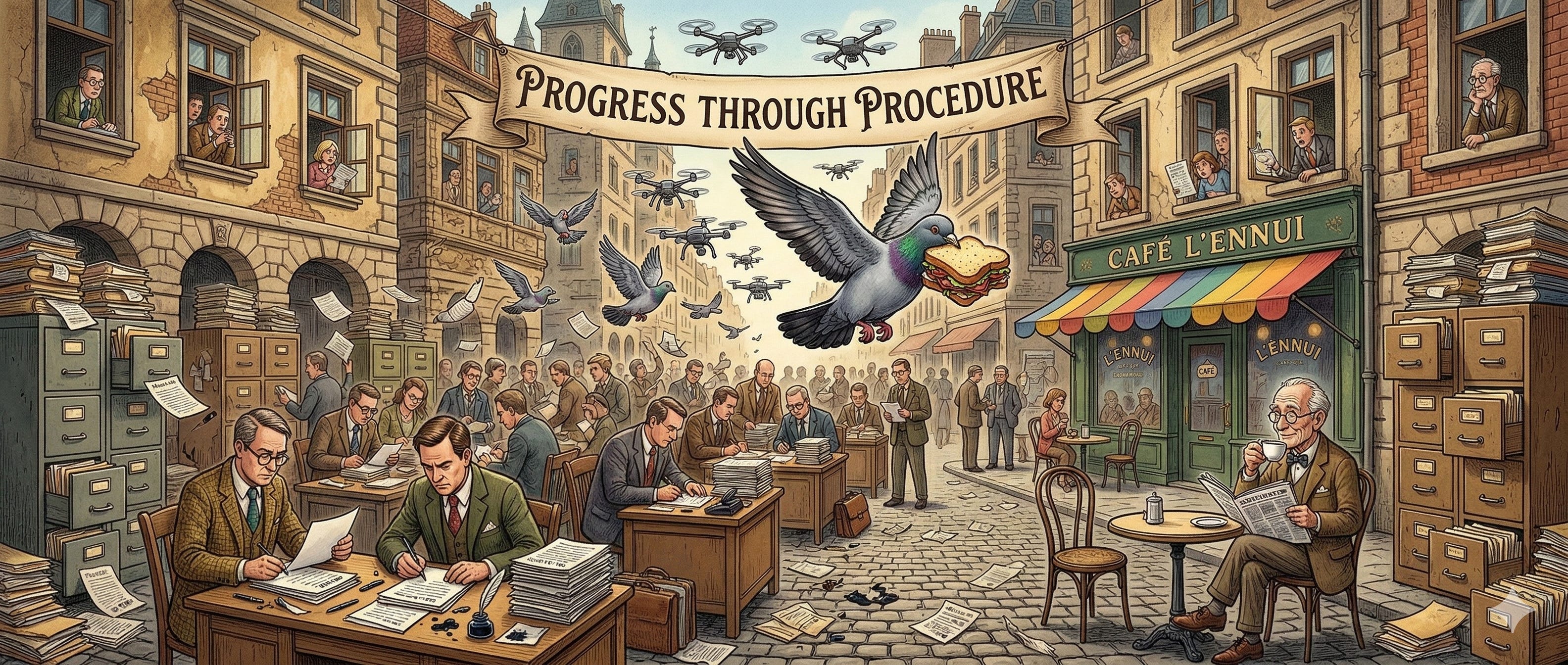
It began, as these things always do, with something small.
A pigeon had stolen a sandwich.
It was an ordinary Tuesday in the city of Orbis - a place that prided itself on being the most orderly municipality in the continental alliance. Nothing happened in Orbis without a process, and nothing was allowed to resolve itself without oversight. The city’s motto, emblazoned on every public building, was “Progress Through Procedure.”
And so, when the pigeon - a gray, unlicensed avian - descended upon the public plaza and absconded with a half-eaten ham-and-cheese from a citizen’s bench, the act was not viewed as a trivial occurrence of urban wildlife doing urban wildlife things.
No.
It was logged.
At precisely 12:43 PM, the victim, one Harold Tims (Citizen Identification #0003912-B), submitted a Formal Complaint Regarding Unlawful Sandwich Appropriation (Form 27-B, subsection Avian) via the city’s digital governance portal, “ResolveIt™.” The form required him to specify, among other things, the sandwich type (meat-based, dairy-involved, condiment presence: “mayonnaise, light”), the estimated flight trajectory of the offending pigeon, whether the sandwich had been wrapped in recyclable materials (it had not), and - perhaps most crucially - a personal reflection on how the incident had affected his sense of civic safety. Harold, to his credit, wrote three paragraphs.
By the next morning, the Department of Incident Response had opened an official case file.
A junior analyst named Marla Finch was assigned to investigate. Marla, twenty-seven, held a Master’s degree in Regulatory Design and a minor in Applied Compliance Psychology. She took her job seriously. To her, every incident was a potential precedent, and every precedent a possible law.
Her first act was to convene an Emergency Stakeholder Coordination Huddle.
Around the table - a collapsible regulation-grade composite purchased through an approved vendor - representatives from six departments gathered: Wildlife Management, for obvious reasons. Food Safety, in case the sandwich posed contamination risks. Urban Cleanliness, since crumbs might attract further pigeons. Public Sentiment Analytics, to monitor outrage levels online. Legal Affairs, to ensure the process met procedural ethics. And Community Harmony, because someone had to use their budget.
The meeting began with solemn efficiency.
“Thank you all for joining on such short notice,” Marla said, adjusting her compliance lanyard. “We are here to address the recent incident involving unauthorized sandwich acquisition by a pigeon within the Central Civic Plaza. The citizen involved has requested both compensation and systemic reform.”
A murmur of agreement spread through the room.
“We can’t allow this to repeat,” said the representative from Urban Cleanliness, who had spent the morning chasing seagulls away from the compost bins. “If one pigeon can take a sandwich today, what stops them tomorrow?”
“Precedent,” nodded Legal Affairs gravely.
Public Sentiment Analytics presented a slideshow: twenty-three social media posts using the hashtag #BirdCrime. Engagement levels were low, but trending upward. “This could escalate,” they warned. “If people start feeling unsafe eating lunch outdoors, it may impact plaza visitation metrics.”
Marla frowned. “Then we’ll need to recommend corrective legislation. A Pigeon Control Ordinance, perhaps.”
The Compliance Whisperer from Legal Affairs raised an eyebrow. “Will that require new enforcement staff?”
“Possibly a task force.”
There was a murmur of approval. Few things excited the city bureaucracy more than a task force. The word alone caused a visible ripple of pleasure across the room, like someone had opened a box of warm pastries at a morning briefing.
By the end of the meeting, the following initiatives had been proposed: a Sandwich Security Protocol mandating citizens to cover all food items when unattended for more than thirty seconds; a requirement that pigeons within city limits be tagged, tracked, and possibly licensed; the introduction of fines for Improper Crumb Disposal; and, in a stroke of marketing genius, a Civic Awareness Campaign titled “Beak the Habit: Don’t Feed Lawbreakers.”
Marla summarized the meeting with satisfaction. “If we move quickly, we can prevent another incident before it happens.”
There was applause.
By that afternoon, a Preliminary Working Draft of the Pigeon Regulation Act was circulated. It was forty-seven pages long, including appendices. Several people described it as “concise.”
The citizens of Orbis had survived wars, recessions, and three separate rebrandings of their public transportation app. But this was different. This was governance in its purest, most distilled form - the belief that every moment of chaos could be gently smothered in the warm, suffocating embrace of policy.
And yet, as the pigeons continued to fly - unlicensed, unrepentant, and entirely unaware of the regulatory machinery being assembled against them - the first whispers of dissent began to stir.
At the café across the plaza, an elderly man named Clive, who had seen too many city councils come and go, sipped his coffee and muttered to no one in particular:
“Maybe it’s just a bird, love. Maybe just let it be.”
No one heard him. The city had already scheduled a Hearing on the Necessity of Pigeon Licensing Standards.
The city council of Orbis met in the Grand Chamber - a glass-and-chrome monument to civic self-regard - to vote on the matter. The session was scheduled for one hour and lasted seven. This was considered a success.
During the opening remarks, Councilor Mayweather described the bill as “a vital step toward reclaiming our skies.” Another councilor, who had not read the bill but sensed opportunity, declared it “a triumph of community-first governance.” The chamber erupted into applause when the mayor proclaimed, “From this day forth, every crumb shall be accounted for.”
And so, with great ceremony and several unnecessary PowerPoint animations, the PRA became law.
Immediately, things got complicated.
The city’s newly formed Avian Oversight Bureau began its work. A thousand small metal bands were ordered from a vendor in Luxembourg - cheapest compliant supplier - each engraved with a unique identification code and the inspirational slogan “Order Is Freedom.” Drones were deployed to tag pigeons. The first week, they managed to attach a tracker to precisely one bird, who promptly flew out of city limits and was later photographed in another jurisdiction, sparking a minor international incident about “avian sovereignty.” Diplomats were involved. Apology memos were drafted. The pigeon, naturally, had no comment.
Still, the Bureau persisted. By week two, new legislation had been proposed: The Inter-Municipal Bird Migration Coordination Act - to ensure “cross-border regulatory consistency.”
Meanwhile, the Department of Urban Cleanliness issued Guideline Addendum 14-B, prohibiting citizens from eating outdoors without a Food Exposure Permit. The permit required watching a mandatory online training video (”Sandwich Safety: Your Role in Prevention”), passing a twelve-question quiz, and agreeing to a data privacy waiver allowing cameras in public plazas to monitor compliance. The quiz had a 38% pass rate. The training video was forty minutes long and featured a narrator who spoke as though explaining death to a child.
A few citizens complained. They were reminded, politely, that civic engagement was both a right and a responsibility, and that non-compliance would result in a fine.
By the end of the month, thirty-seven new rules, eight addenda, and one international memorandum had been enacted - all stemming from the initial pigeon-sandwich event.
The pigeons, to their credit, adapted. They learned to recognize the sound of the tagging drones and began nesting under bridges, where the GPS signals couldn’t reach. This unexpected behavior required the formation of a Bridge Ecology Subcommittee to study “subterranean avian activity and its impact on civic order.”
The Subcommittee met every Thursday. It accomplished nothing every Thursday.
It was during one of these meetings that Marla, now promoted to Senior Associate of Interdepartmental Harmonization, began to sense that something had gone wrong.
They were discussing whether pigeons should be required to register seasonal migration plans in advance when she finally asked, quietly, “Are we… still talking about sandwiches?”
A long pause followed.
The room stared at her as though she had suggested abolishing gravity.
Council Liaison Everett cleared his throat. “This isn’t about sandwiches anymore,” he said, in the solemn tone of a man defending civilization itself. “This is about governance. About showing that Orbis responds.”
Marla nodded mechanically, though she couldn’t shake a creeping thought: Responds to what, exactly?
Across the city, small absurdities began to accumulate like sediment in a river that no one was allowed to clean without a permit.
A café owner was fined for leaving breadcrumbs on an outdoor table - classified as Attractive Nuisance, Avian Category. A child’s drawing of a pigeon was confiscated at school for “depicting an unlicensed animal.” The teacher, visibly shaken, filed a report. The child, aged six, was offered counseling. The Department of Licensing began receiving applications from people asking if they, too, needed to be tagged “just to be safe.” One woman reportedly arrived at the bureau with a metal band she’d fashioned herself and asked which ankle was standard.
Every enforcement produced an unintended side effect, which produced a memo, which produced an amendment, which produced another law.
It was said that if you listened closely at night, you could hear the faint rustle of legal documents multiplying in filing cabinets, breeding like rabbits in the dark.
The city’s legal database eventually grew so large that it required its own power substation. When the first blackout occurred, the Department of Energy drafted the Continuity of Bureaucratic Operations Act, ensuring that in case of total infrastructural collapse, all regulatory servers would remain active via emergency hamster-wheel generation. Three departments were tasked with acquiring the hamsters. A fourth was formed to regulate the hamsters’ working conditions.
By now, even Marla’s inbox had become a kind of digital labyrinth. Dozens of unread memos, each tagged URGENT, each referencing new rules about the proper way to request clarification about old rules. She would wake up at night, certain she had missed a compliance review, only to realize she was dreaming about it. Then she would lie awake wondering if she needed to file a report about the dream.
And yet, the system churned on.
The mayor held a press conference to celebrate “a historic reduction in unregulated avian behavior.” When asked by a journalist how this was measured, he smiled confidently and said, “We’re forming a task force to find out.”
Somewhere in the back of the room, an old man named Clive - the same one who had watched the first meeting from the café weeks ago - leaned on his cane and muttered, “Maybe it’s not the pigeons that need tagging.”
No one heard him.
The next morning, the city council convened an Emergency Session on Escalating Public Dissatisfaction Concerning Overregulation.
It lasted nine hours.
The outcome: a proposal to draft the Citizen Contentment Assurance Framework.
The Citizen Contentment Assurance Framework was hailed as Orbis’s most ambitious piece of legislation to date.
Its purpose was simple: to ensure that no citizen ever again felt the need to complain about “too many laws.”
To accomplish this, the Framework created a new department - the Office of Regulatory Well-Being - whose mandate was to “maintain the public’s emotional alignment with governance outcomes.” In practice, this meant ensuring that whenever someone expressed frustration with the city’s laws, they were swiftly invited to a Listening Consultation Experience™, where an empathetic civil servant would nod reassuringly while logging their concerns into a database that automatically generated more regulations to prevent similar dissatisfaction in the future.
By this point, the Pigeon Regulation Act had evolved through seventeen revisions, five cross-departmental harmonization cycles, and one renaming initiative (it was now the Urban Avian Behavior Optimization Act, or UABOA, which everyone pronounced “you-BOA” and no one enjoyed saying). Each change spawned new forms, new compliance audits, and new interpretive disputes about whether “winged entities” included bats, butterflies, or recreational drones. One particularly heated session devolved into a forty-minute argument about whether a badminton shuttlecock counted as a feathered object under Section 9.
The number of active committees exceeded the number of pigeons.
One Thursday morning, Marla - now Deputy Undersecretary for Harmonized Oversight of Adaptive Legislation - arrived at work to find her office door replaced by a biometric scanner. A memo on the wall informed her that physical keys were no longer compliant with the Secure Access Modernization Directive. The scanner, unfortunately, required a clearance level one higher than her own.
She sent a help ticket to Facilities. Facilities replied that they couldn’t override it without approval from Security. Security responded that they would need an incident report filed with IT. IT automatically generated a new ticket requiring Facilities to authorize the repair.
Marla stood in the hallway for six hours, watching the system protect her from herself.
That evening, a city drone buzzed past the window carrying a public announcement banner: “YOUR SAFETY IS OUR PRIORITY. COMPLIANCE IS FREEDOM.”
She decided to go home early. Getting approval to leave early took an hour and a half.
Across the city, life had become a kind of performance art of obedience.
Pedestrians walked in perfectly straight lines, as per the Directional Movement Clarification Act (a logical extension of the Pigeon Ordinance, though no one could quite explain how). Restaurants served pre-sealed meals to comply with the Open-Air Food Containment Mandate. Conversations in public spaces were limited to five approved topics to ensure Civic Discourse Consistency. The topics were: the weather (positive framing only), approved municipal achievements, sports (non-confrontational), gratitude for governance, and a rotating wildcard category that was, this month, “the benefits of indoor dining.”
The government even introduced Regulation Literacy Week, during which citizens were encouraged to “celebrate their right to be responsibly constrained.” There were festivities. The festivities were mandatory.
And yet, for all the order, the city had grown strangely quiet.
People stopped eating outdoors entirely - not out of protest, but out of exhaustion. The plaza that once bustled with laughter and pigeons now stood empty, a clean, efficient void. The Department of Urban Cleanliness declared it a triumph and proposed commemorative plaques to honor the success of the Pigeon Act.
But without food, the pigeons left. Without pigeons, the cafés closed. Without cafés, the plaza revenue dropped, requiring the formation of the Economic Revitalization Through Regulation Initiative, which proposed a series of compulsory outdoor lunch breaks to restore civic vibrancy. Citizens were fined for failing to participate. They were also fined for participating incorrectly.
When the city’s central data hub finally crashed under the weight of overlapping compliance software, all services ceased at once. Traffic lights froze on red. Elevators stopped between floors. Thousands of forms remained permanently “In Review.” A man on the fourteenth floor of a municipal building reportedly lived in an elevator for two days before anyone noticed, and even then, the first responder asked if he’d filed a Stuck Elevator Incident Form.
An emergency meeting was called.
“Citizens are unable to access the complaint portal,” said the head of the Office of Regulatory Well-Being.
“This is catastrophic,” replied the mayor. “How can we address their concerns if they can’t complain?”
A proposal emerged almost immediately: the Public Sentiment Restoration and Emergency Governance Continuity Act, or PSREGCA. Its goal: to regulate the process of unregulated downtime. No one could pronounce the acronym. Someone suggested forming a subcommittee to rename it. The subcommittee was approved on the spot.
Marla stared at the draft legislation projected on the screen - 982 pages long, including a 47-page glossary defining the term “response.”
She realized, with a kind of slow, unbearable clarity, that the city was no longer governing anything. It was only responding - endlessly, reflexively, to itself.
Every action had become an incident, every incident a precedent, every precedent a law. They had mistaken motion for progress, paperwork for wisdom, compliance for care.
When she left the chamber that night, the streets were silent. The city lights flickered, not from power shortage, but from the dimming pulse of a system collapsing under its own certainty.
Outside City Hall, she saw a pigeon - small, untagged, impossibly free - pecking at a discarded crust near the curb.
For a moment, the absurdity of it all cracked something open in her. She laughed - a dry, helpless sound that startled even the bird.
“Go on,” she whispered. “You’ve earned it.”
The pigeon cooed, unimpressed, and flew into the dark.
Behind her, a siren began to wail - an automated voice announcing: “UNAUTHORIZED AVIAN ACTIVITY DETECTED. RESPONSE TEAM DEPLOYED.”
Marla didn’t turn back. She kept walking. Past the cameras. Past the posters. Past the line of patrol drones scanning for violations.
No forms, no meetings, no incident reports.
Just one unregulated act of leaving.
In the months that followed, the city of Orbis continued to issue laws long after most of its citizens had stopped showing up. Servers hummed faithfully, drafting amendments to ordinances that no one enforced, regulating behaviors that no one performed.
Somewhere, deep in the archives, a dusty folder labeled Case 27-B: Sandwich Theft, Avian Involvement still sat unresolved, its final note reading simply:
Action required.
It would remain that way forever.